
Contents

🌞 Can a Solar Storm Affect NASA’s MAVEN? Scientists Explain the Real Risks to Mars Orbiters
In recent months, solar activity has increased significantly, raising concerns about the potential impacts solar storms may have on spacecraft — especially the probes orbiting Mars. One of them is NASA’s MAVEN, a crucial mission that studies the Martian atmosphere and helps scientists understand how the planet lost most of its protective layer over billions of years.
But the big question is: Can a solar storm really affect MAVEN? And more importantly, what are the real risks for missions operating millions of kilometers from Earth?
☀️ What Is a Solar Storm?
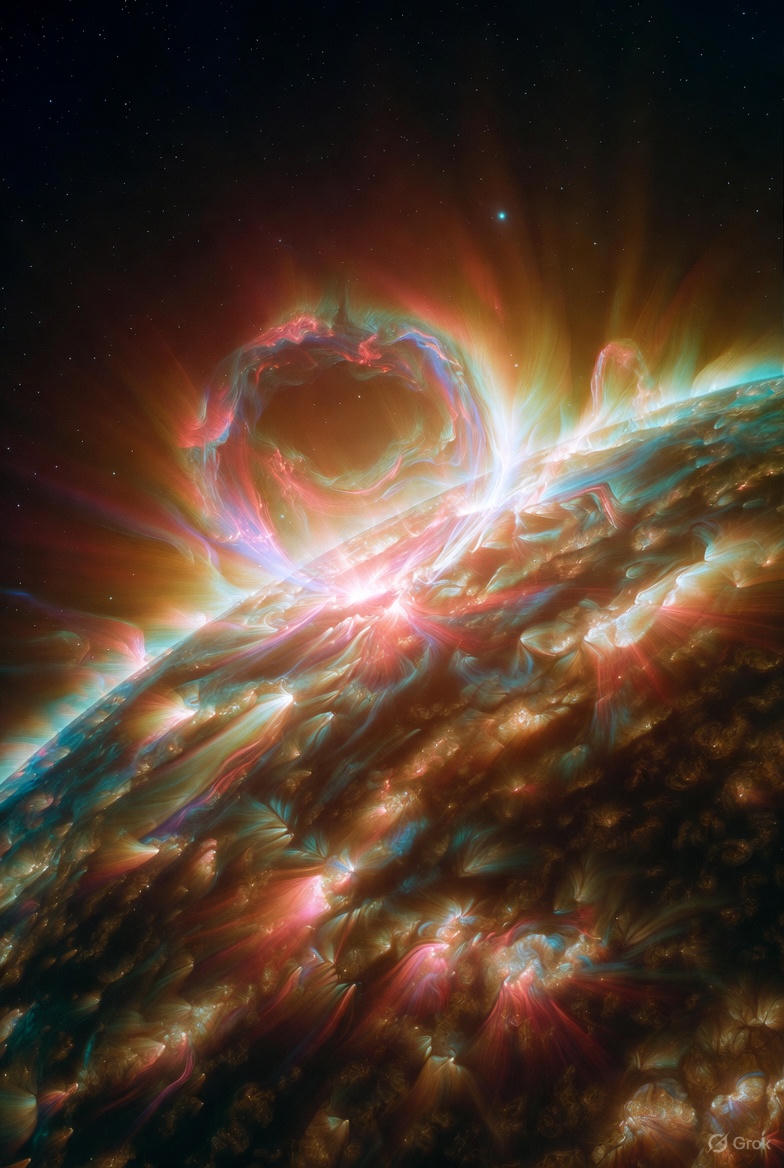
Solar storms occur when the Sun releases large amounts of radiation and charged particles into space. These events may include:
-
Solar flares
-
Coronal Mass Ejections (CMEs)
-
Increases in solar wind intensity
When these energetic particles reach planets or spacecraft, they can interfere with electronics, communications systems, and sensitive scientific instruments.
🔴 Effects on Mars Orbiters
The MAVEN (Mars Atmosphere and Volatile Evolution Mission) is equipped with delicate instruments that study particles and magnetic fields around Mars. During an intense solar storm, the spacecraft may face:
✔ Communication Interference
Solar radiation can create electromagnetic noise, making it harder for MAVEN to send and receive data through NASA’s Deep Space Network.
✔ Electronic Overload
High-energy particles can strike the spacecraft’s circuits, forcing MAVEN into safe mode — a protective state where only essential functions remain active.
✔ Temporary Changes in the Martian Atmosphere
When strong solar activity reaches Mars, the upper atmosphere becomes more turbulent and denser.
This increased density can put additional drag on orbiting spacecraft, requiring orbital corrections to maintain stability.
✔ Radiation Spikes on Scientific Sensors
Because MAVEN measures energetic particles, a powerful solar event can overload detectors or produce abnormal readings.
🛡 How NASA Protects MAVEN
Despite the risks, spacecraft are engineered to withstand extreme conditions. MAVEN is protected by:
-
Shielded electronics
-
Automatic safe-mode systems
-
Redundant components
-
Emergency communication protocols
-
Continuous space-weather monitoring
NASA also observes the Sun with missions like SOHO and the Solar Dynamics Observatory, allowing teams to anticipate solar storms and adjust operations in advance.
🔍 Should We Be Worried?
Experts say that solar storms pose risks, but they are predictable and manageable. MAVEN has already weathered several solar events in previous years and continues to operate normally.
The primary concern is not losing the spacecraft permanently, but experiencing temporary communication blackouts or data corruption, which could delay scientific progress.
🚀 Conclusion
Yes — solar storms can affect MAVEN and other Mars-orbiting spacecraft. However, thanks to robust engineering and constant monitoring, the likelihood of a catastrophic failure is low.
The Sun remains a challenge for deep-space exploration, but it also provides valuable scientific opportunities: every extreme solar event helps researchers better understand how planetary atmospheres evolve — including Mars’s.